 WOES OF WEALTH EDITORIAL
everybody, except saints and mad-caps has the longing to acquire wealth as it is indispensable for living well. Acquiring and holding of wealth is also a fundamental right of every citizen according to the constitution of Bangladesh. But wealth sometimes brings woes instead of comfort and happiness, if the greed for acquiring it knows no end.
The number of millionaires in the country could be counted on one’s fingers just two decades ago. But we recently witnessed a boom in billionaires, who illegally amassed enormous wealth. The amount of money and the wealth that they amassed by plundering the public exchequer has come as a shocking revelation.
The recent revelation of the ill-gotten wealth of Tarique Rahman, the eldest son of former prime minister Khaleda Zia, his closest friend Giasuddin Al-Mamun, Khaleda’s political secretaries Mosaddek Ali Falu and Haris Chowdhury, and former ministers Najmul Huda and Lutfuzzaman Babar, has added a new chapter in the history of plundering and bribery. Their wealth has now become woe for them.
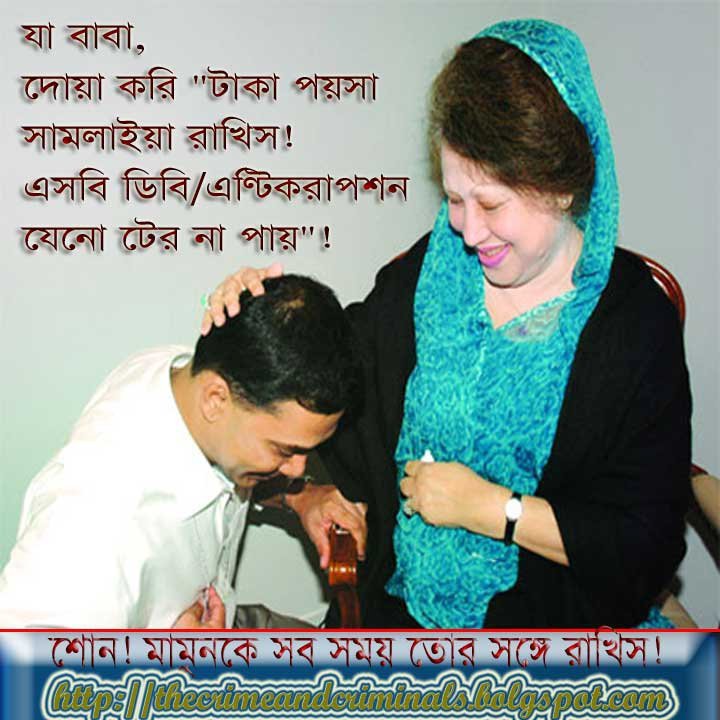
Tarique Rahman, the most talked about suspect, became a billionaire in just a few years with the blessings of his mother. Tarique reportedly has admitted to having bank accounts in five countries — Malaysia, Singapore, Thailand, South Africa and Switzerland, where he has siphoned off crores of Taka earned by extortion and bribery. The Malaysian government has frozen his $230 million, as he failed to explain the source of the money.
Tarique established an alternative power house in Hawa Bhaban, the BNP chairperson’s Banani office, and was involved in interfering in almost all the businesses and contracts in the country. Tarique, now under custody, has disclosed his financial web to the joint interrogation cell.
Hailing from an extremely poor family, Giasuddin Al-Mamun has become one of the richest men in the country within a few years by resorting to all sorts of illegal activities under direct patronization of Tarique. Mamun, the detained controversial businessman who also siphoned off money to different countries, issued cheques for repatriation of Tk 20 crore 41 lakh from Singapore. Mamun owns several houses in the city’s prime areas, including a magnificent house at Gazipur for weekend recreation.
It really beggars the imagination to think of the amount of wealth that has been amassed by Mosaddek Ali Falu, who enjoyed enormous power and privileges as a political secretary to the former Prime Minister Khaleda Zia. Falu owns four multi-storied buildings in the capital and a villa at Gazipur. A mini-zoo has been setup in his villa. Besides, he owns around one hundred bighas of land in Savar.
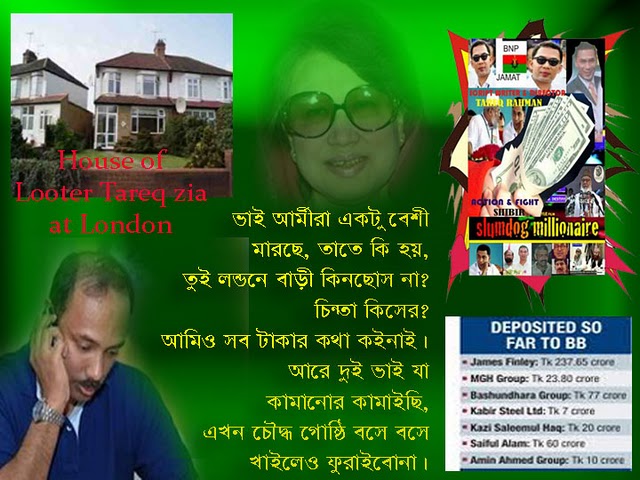
Haris Chowdhury, another political secretary to former Prime Minister Khaleda Zia, also amassed immense wealth using his close link with the prime minister. His ill-gained properties include five houses in Dhaka, fixed deposits for Tk ten crore, and a house and a shopping mall in London.
Besides, he owns a large number of shares of different companies, worth crores of Taka. Along with his political post, Haris runs a humble car sales centre in the capital. An anti-graft tribunal has sentenced him to three years imprisonment for not submitting his wealth statement to the ACC.
Former state minister Lutfuzzaman Babar hushed up a murder case for such an immense amount, that many of us cannot even dream of earning in a lifetime. Babar’s portfolio was a magic lamp, and he made a huge fortune by abusing official power.
Two sons of former finance minister M. Saifur Rahman took lease of 200 acres of government land in Srimangal upazila almost free of cost. Shafiqur Rahman Babu took lease of 100 acres of land worth Tk 95 lakh for only Tk 500, while another son, Kaisar Rahman, got 100 acres of government land to set up a fish farm. Saifur’s eldest son, Naser Rahman, is already under custody because of suspected corruption.
The trial of bigwig corruption suspects has frightened their wives and children, because family members of many accused have already been arrested. The wife, daughter, and two sons of former state minister for power, Iqbal Hasan Mahmud, have been sent to jail. They were charged with assisting Mahmud in amassing wealth through corruption.
Sabera Aman, wife of former state minister Amanullah Aman, has been sentenced to three years imprisonment on graft charges. Sigma Huda, wife of former minister Najmul Huda, was sent to jail on a stretcher. Khoshnud Asgar, wife of former BNP lawmaker Ali Asgar Lobi, is also in jail custody in a graft case. Falu’s wife Mahbuba Sultana is on the run to evade arrest.
Cases have also been filed against the wives and children of many high-profile corruption suspects, including some former ministers. Though the people have welcomed this crusade against corruption, they are not in support of such actions against the wives and children of the bigwig corruption suspects.
The government may take a lenient view of the wives and children of the corruption suspects, if they are accused of only having ill-gotten wealth in their names. They may be spared if they give a declaration that they do not own the money or the property kept in their names.
According to a newspaper report, the government has so far listed only 154 clean politicians, searching across the country through its intelligence agencies, who are eligible to be candidates in the next parliamentary election. The list includes 70 persons from BNP, 56 from AL, 13 from Jatyo Party (E), 8 from Jamaat-e-Islami and 7 from LDP. Unfortunately enough, no top leaders of these political parties have been included in the list.
The revelation of the enormous ill-gained wealth of some bigwigs has begotten a feeling of scorn among the people. The question that is weighing on their minds is how much wealth does one need to lead an ultra-luxurious life? Most of these persons come from poor families. “From rages to riches” is the phrase that truly describes their condition.
These imprudent persons, having endless greed for wealth, had no time to think that such wealth might be a snare for them. Tarique Rahman, who shed tears in the court, revealed his feeling of the woes of wealth. Endless greed for wealth has made him the symbol of corruption.
In a rare event in the country’s history, the powerful and supreme individuals who had created a culture of impurity, where mindless plundering and high corruption thrived, are now facing trail at the newly constituted special courts. They have now to endure the woes of the wealth that they amassed illegally at the expense of the country. The people want a thorough cleansing once and for all, for a decent body politic where their aspirations could be realized. They really do not want to live in limbo any more.
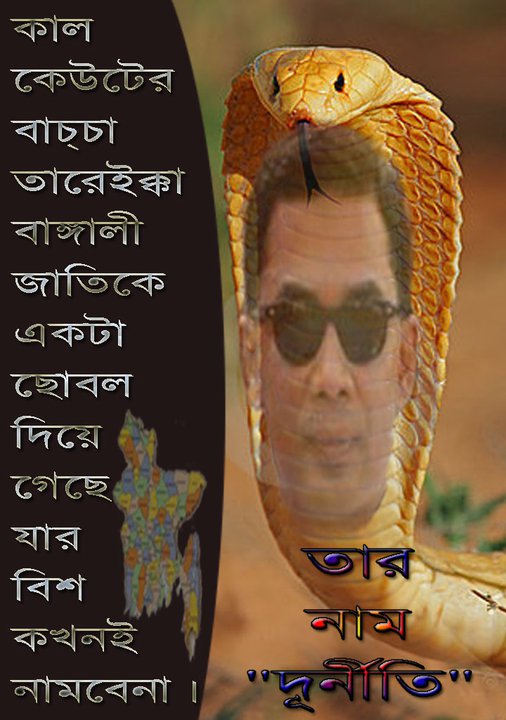
TAREK ZIA or Tareq rahman, Father- Sector Commander, President Major Ziaur Rahman, Mother- Mrs Khaleda zia uneducated, uncapable prime minister of 20/21th century, the step wife of Mossaddek Ali Falu. Brother- Arafat Rahman koko; one of the beneficiary of Khaleda govt and nominated best addicted Young last five years in a row. Friends- Fokinnirput Gias Al Mamun, thieft of the year 2001/2006 and Bisisto Modkor, Juary, Ganzoti,Hiroinchi and Magibaz.R chorer khonir kotha bolsen? Chorer khoni dekhte chan? Tahole Mohamanno Tarek zia Shaheb er pet katlei chorer khoni ber hobe. Or chaye boro chor r rokto chosha Bangladeshe akhno poyda hoyni.PJamaat
misrulembarrasses Bangladeshi expats Tue, Jun 28th, 2005
Dhaka, June 28 (BDNEWS)- Leader of the opposition in parliament and Awami League Chief Sheikh Hasina said, the Bangladeshi expatriates are facing embarrassment for poor law and order and human rights situation due to misrule of BNP-Jamaat alliance government.
Former Prime Minister Sheikh Hasina said this while addressing a gathering of leaders of Russia unit of Awami League, Bangladesh-Russia Chamber of Commerce and Industries (BRCCI) and Bangladesh-Russia Friendship Council at her hotel suite Tuesday prior to departure from Moscow for London.
Hasina urged all to free the country from the clutches of BNP-Jamaat coalition government whom she termed as the “image destroyer of the country.”
The government is trying to save the killers of the former finance minister SAMS Kibria murder and other popular Awami League leaders and August 21 grenade attack in the name of trial and investigation, she accused.
 The government is diverting the August 21 grenade attack issue in political interest of the ruling party, Hasina remarked.
The opposition leader said the government is thwarting the systematic movement of the opposition by resorting to inhuman torture and repression.
The government administration cannot act neutrally due to massive politicisation, she alleged adding, “Democratic institutions of the country are on the verge of collapse due to politicisation.” To save the country from the debacle, all opposition parties are continuing movement to initiate fall of the government, she said. Awami League presidium member Sheikh Fazlul Karim Selim MP, international affairs secretary Alhaj Syed Abul Hossain, forest and environment affairs secretary Dr. Hasan Mahmud, member of sub-committee on international affairs Ambassador Mohammad Ziauddin, Russia unit Awami League President Dr. Motaleb Bahar Patowari, its general secretary Dr. Soumitra Dev Partho, its former President Dr. Shafiqul Islam, BRCCI President Mia Rafiqul Islam Arju and its former President Mia Abdus Sattar, advisor of Bangladesh-Russia Friendship Council Mojumder Amin and a good number of leaders and activists of the party were present at the gathering. Earlier, former Prime Minister and opposition leader Sheikh Hasina called on Deputy Prime Minister of Russian Federation Alexander Alekseyev and Deputy Speaker of the State of Duma (parliament) Lubov Silizka in their offices separately. During her meeting with Russian leaders, they discussed different bilateral issues including strengthening of parliamentary democratic system. Meanwhile, Awami League chief and leader of the opposition in parliament Sheikh Hasina has been elected as foreign member of the Russia
Academy of Natural Sciences. The announcement was made at a programme of the academy Monday night. Deputy Speaker of Russian parliament and Chairman of Liberal Democratic Party Zhirinovsky, chief of international affairs committee Mikhail Margelov, member of the upper house Zabraylov, chief of Bangladesh-Russia parliamentary committee Tigunov and Council of Federal Councillor of Russian Federation Umar Dzhabrailov and diplomats of different countries were present at the programme. The academy also hosted a dinner in honour of Sheikh Hasina
 একাত্তুরের মুক্তিসেনা
Former premier and BNP Chairperson Khaleda Zia went berserk and yelled at the top of her lungs asking whether her son was such a thief that he would have to flee the country, said former state minister for home affairs Lutfozzaman Babar during questioning by the Task Force for Interrogation (TFI).
Babar was recalling his experience in planning Tarique Rahman’s supposed departure from the country to avoid the incarceration he is currently in.
“Before Tarique Rahman was arrested, we used to get information from different sources that he might get caught. So I, Mannan Bhuiyan, Falu and Qamrul held a secret meeting in Mannan’s residence and decided that Tarique would be sent abroad for two or three years,” Babar told the TFI.
He said they planned that Tarique would be brought back home with a hero’s welcome if BNP would come back to power again.
“As everything got finalised Falu narrated the matter to Khaleda Zia using my name before he took her to Hawa Bhaban in the same evening. Listening to the plan, madam went ballistic and began shouting at the top of her lungs in her residence,” Babar said.
“Arriving at Hawa Bhaban, she started yelling again asking where are the conspirators Mannan Bhuiyan and Babar? Is my son such a big thief that he will have to flee the country?” Babar quoted Khaleda as yelling.
Babar also told the interrogators that about a year or so ago Khaleda Zia called him in and told him that she had Tk 20 crore in different places which she wanted to keep with one Kamal. She also told him that the money would later be used during elections.
Sources claimed that Babar told the investigators that Khaleda wanted to know from him whether he knew any trustworthy people with whom the money could be kept safely for a year, and in reply Babar told her that finding such people would be a very tough task for him.
Babar also told the interrogators that when Khaleda raised the issue again on the next day when he went to meet her, he asked his brother to keep the money. His brother then got angry with him telling him not to get involved in such matters warning him that those kinds of activities would come back to haunt him one day. Babar said a day later he asked his brother whether he could help him as his ‘madam’ had given him the task trusting him.
According to the sources, Babar told the interrogators that some days before he asked Khaleda for an approval to open up a bank and then he sat with some people to work out a plan. However, they told Babar that banks require a big amount of investment and the money would be collected in the name of BNP, a portion of which would be given to Babar as his share.
Babar also said he whitened a large amount of money through his brother in the name of a company after his meeting with the aspiring bank owners. The former home ministry boss also said later he brought the matter to Khaleda’s attention who introduced him to a man who later turned out to be the person who had arranged to hundi Tk 20 crore, a portion of which Babar used to invest in the banking business he was trying to embark on.
Babar said suddenly he came to know that the Tk 20 crore was part of the money that had been taken from Warid Telecom as a bribe.
Tareq Rahman: fucking son of khaleda zia
At the age of 42 Tareq made his first significant step in politics in 2002, when ruling Bangladesh Nationalist Party was announced that he had been promoted to a senior position. Mr Rahman rapidly acquired a reputation for being a “hatchet man” for enforcing party discipline. Mr. Rahman appears to prefer working behind the scenes. His private office “Hawa Bhavan” was widely viewed by political opponent Awami League as the driver of the country’s mismanagement and corruption during 2001 to 2006 while his mother Khaleda Zia was the Prime Minister. He rarely speaks to the press, and is renowned for his reticence in the few media interviews he has given.
Rahman’s arrest
Under the present care taker government on March 7, 2007, Tareq Rahman was arrested by law enforcing Joint Forces. He is charged with extortion and other corruptions. He initially denied the charges. But later the situation turned dramatically when other arrested BNP political leaders started to disclose information on Tareq Rahman’s corruption. Especially the arrest of former state minister for home affairs Lutfozzaman Babar on May 29, 2007 brought a huge downfall of Tareq’s public image. Mr. Babar provided evidence of Tareq Rahman’s corruption. But trail has not started for these charges yet. Khaleda Zia claimed in the court that her sons had not committed any crime as they did not need money.
================================================================================
Bangladesh’s Interim Government has tightened its grip on civil liberties while it’s anti graft campaign gathers speed, sparing none in its path. Yesterday evening Fakhruddin Ahmed’s provisional administration outlawed all political activities “public or private”, because “certain parties have been misusing flexibility conceded to them”. A state of emergency has been in act in the country since January 11th last, following weeks of violent protest between activists from the majority political parties. The general elections, which were due to be held on the 22 of February, have been put off indefinitely. Fakhruddin – ex govern of the central bank – has pledged to put an end to corruption before establishing a date for elections.
In recent weeks security forces have arrested over 150 politicians, charged with corruption. Yesterday it was the turn of Tareque Rahman, joint Secretary General of the Bangladesh Nationalist Party (BNP) and son of ex leader Khaleda Zia. Police are holding him for interrogation on charges of extortion to the value of 145 thousand dollars; but other claims against him are far more serious. Analysts in country contacted by AsiaNews tell that in the last 5 years of the BNP government – lead by his mother – Tareque was “the epicentre of high level crime and corruption: an example are the billion dollar contracts approved by him, such as those given to Chinese companies to build enormous power plants. These companies did not posses the technical now how to build the plants which from the very start have struggled to meet 50% of their expected output”.
The UN anti corruption agency declared Bangladesh “the most corrupt country in the world” 5 years in a row. In 2006 the prize passed into other hands, leaving Bangladesh in “only” third place. “Corruption is widespread, from the postman to ministers, from teachers to judges” experts note. “People constantly discuss it, politicians make promises, but no one actually believes its levels can even be reduced”.
————————————————————————————–
If Ershad is barred from running in next election due to corruption charges, then what about Khaleda Zia and her family members. She must explain to people how her family became one of the richest families in the world from the day of broken suitcase and ragged T-Shirt. Her son Tareque Zia is well known as Mr.10%.
By special blessing of Khaleda Zia , from the street Falu Mia earned more than Tk1,000 Cr. Abdul Mannan Bhuiyan became the owner of private TV Channel.
Vicious circle of syndicate under direct patronization of Tareque Zia plundered thousands of crores Takas from the pocket of common people by hiking the prices of all commodities. In terms of corruption, Ershad was infant compared to Khaleda Zia’s family all MPs and Ministers of immediate past BNP-Jamaat govt.Most of the people in Bangladesh did not support the massive corruption done by BNP-Jamaat alliance, so people won’t vote for them again. People will vote for a new govt. to punish Khaleda Zia, Tareque Zia and all other MPs and Ministers of immediate past BNP-Jamaat govt.All their properties will be seized by the newly elected govt. to form a National Trust.
So, In Coming Election the Main Agenda is to defeat toxic BNP-Jamaat alliance in order to put Khaleda Zia, Tareque Zia and all other thug MPs and Ministers of erstwhile BNP-Jamaat govt. in jail for record breaking misrule and massive corruption.
Former state minister for home Lutfozzaman Babar spilled more beans as he told investigators yesterday that he had negotiated a $10 million fast-track frequency allocation deal for Warid Telecom and the booty was shared by Arafat Rahman Koko and former BNP MP Ali Asgar Lobi.
Of the amount, $9 million was given to former prime minister Khaleda Zia’s younger son Koko and $1 million to detained BNP leader Lobi who had close links with detained BNP Senior Joint Secretary General Tarique Rahman and his Hawa Bhaban.
Babar also revealed during interrogation that Koko and former finance minister Saifur Rahman’s son Tony took commission from a Chinese company in the name of giving it a contract for supplying telecommunications equipment. He, however, denied his involvement in the deal.
On the controversial purchase of 1,970 vehicles involving Tk 121 crore from the government coffer and a huge counterpart fund from a donor agency, he told the investigators that he did not go through the documents before signing the deal.
“It was my mistake. I even did not go through the file before signing it,” Babar was quoted to have said during interrogation.
The former state minister claimed that he had no option but to approve the controversial vehicle purchase for various law enforcement departments “under pressure from the high-ups”. Pacific Motors owned by former foreign minister M Morshed Khan was the prime beneficiary of the purchase proposal.
Babar, who is now on a four-day police remand, said BNP’s Senior Joint Secretary General Tarique Rahman was the main backer of Pacific Motors.
The government decided to procure the 1,970 cars ahead of the Saarc summit in the capital in 2005.
The police headquarters floated a tender in which 16 importers participated. But at the last moment, the authorities changed the conditions of bidding through a circular in such a way that allowed only two importers to participate. That prompted the other bidders to lodge complaints with the government alleging corruption in the bidding process, but that did not work.
Sources said the former state minister also confessed that an official of the Bangladesh High Commission in Singapore used to look after his business there.
Sources said the former state minister gave the investigators information, which they later found to be false. Babar gave the false information to save himself, the sources added.
Babar also confessed to owning a lot of plots and flats in the names of his relatives.
Meanwhile, Tk 20 crore, which Babar took as bribe from Bashundhara Group, was deposited in the central bank’s government exchequer on Wednesday in nine cheques and pay orders.
A Bashundhara Group director told the joint forces that Babar took the money in exchange for not implicating Bashundhara Group owner Ahmed Akbar Sobhan’s son Shafiat Sobhan in the killing of another director of the conglomerate Humayun Kabir Sabbir.
The former state minister asked the Bashundhara men to deliver the money to Prime Bank Director Qazi Saleemul Huq who was supposed to return the money to Babar at a later time, sources said.
After receiving the bribe, Babar allegedly instructed the police not to proceed with the case and the Bashundhara director’s murder still remains unsolved. He also allegedly let Sobhan’s son Shafiat fly out of the country.
Bashundhara Chairman Ahmed Akbar Sobhan is on the Anti-Corruption Commission list of graft suspects. He escaped to London soon after the anti-graft drive began and has been hiding abroad since then.
==============================================================================
ZIAUR RAHMAN REHABILITATE THE RAZAKARS AND BANGABANDHU MURDERERS
Ziaur Rahman, a Major in the Pakistan Army, Zia’s unit (2/5 East Bengal Regiment) took control of the Kalurghat radio station in Chittagong at the onset of the Bangladesh Liberation War and on behalf of Bengali nationalist leader (Father of the Nation)Bangabandhu Sheikh Mujibur Rahman.made the most widely transmitted declaration of independence of Bangladesh which was the third and last in a series of such declarations. Recognized as a war hero, he was honored with the second highest national award Bir Uttom in 1972. A high-ranking accomplished officer in the Bangladesh Army, Zia was appointed chief of army staff in course of dramatic events that evolved following the assassination of Sheikh Mujibur Rahman in 1975 by a group of junior military officers and these army personnel met Ziaur Rahman at his residence to killed Sheikh Mujibur Rahman.
This was followed shortly by another coup and counter-coup and ultimately led to the consolidation of power under Zia as Deputy Chief Martial Law Administrator. The counter-coup, sometimes referred to as a sepoy mutiny was organized by the socialist Colonel Abu Taher.
Ziaur Rahaman assumed the office of the President of the country in 1977 He engaged himself in politics by floating a political party that came to be known as janodal. Later he founded the Bangladesh Nationalist Party. For achieving popular support, he adopted policies bringing the government increasingly under Islam, which he included in the national constitution. It has been alleged that Zia helped individuals involved in the assassination of Sheikh Mujib rehabilitate home and abroad, immunized by the Indemnity Act. He also came to be known as Mr. Clean for his unquestionable integrity.
Coup of 1975 and its aftermath
On August 15, 1975 Sheikh Mujib and his family were killed by a group of military officers. One Sheikh Mujib’s cabinet ministers Khondaker Mostaq Ahmad was appointed the president and, subsequently, Major General Ziaur Rahman was appointed as the army chief after removal of Major General Shafiullah. However, the coup of 15 August caused a period of instability and unrest in Bangladesh and more so across the ranks and files of the army. Brigadier Khaled Mosharraf and the Dhaka Brigade under Colonel Shafat Jamil made a counter-coup on November 3, 1975, and Ziaur Rahman was forced to resign and was put under house arrest. A third coup was staged under Colonel Abu Taher and a group of socialist military officers and supporters of the left-wing Jatiyo Samajtantrik Dal on November 7, called the “National Revolution and Solidarity Day” (Sipoy-Janata Biplob) (Soldiers and People’s Coup) Brigadier Khaled Mosharraf was killed and Colonel Jamil arrested, while Colonel Taher freed Ziaur Rahman ( After few months Ziaur Rahman arrested and execute Colonel Taher )and re-appointed him as army chief. Following a major meeting at the army headquarters, an interim government was formed with Justice Abu Sadat Mohammad Sayem as chief martial law administrator and Zia, Air Vice Marshal M. G. Tawab and R ear Admiral M. H. Khan as his deputies. Zia also took on the portfolios of home affairs, finance, industry and information along with becoming the army chief of staff. However, discipline in the army had totally collapsed and it was difficult to disarm the soldiers and put them back to the barracks. Fearing that Colonel Abu Taher, who in fact rescued him few months earlier, would attempt to organise another revolt, Zia ordered his arrest. Following a secret trial in a military court, Zia authorised the execution of Colonel Taher on July 21, 1976. Zia became the chief martial law administrator following Justice Sayem’s elevation to the presidency on November 19, 1976. He tried to integrate the armed forces, giving repatriates a status appropriate to their qualifications and seniority. While this angered some veterans of the Mukti Bahini, who had rapidly reached high positions following liberation in 1971, Zia defused potential threats from discontented officers by sending them on diplomatic missions abroad.
Ziaur Rahman Rehabilitate the war criminals and former Prime Minister Shah Azizur Rahman was one of them (Bengali: শাহ আজিজুর রহমান) (1925 – 1988) was a Bangladeshi politician who served as the Prime Minister of Bangladesh. However, he was the subject of considerable controversy for his collaboration with the Pakistan Army against the struggle to establish Bangladesh. Shah Azizur Rahman was born in Kushtia of the province of Bengal (now in Bangladesh). As a student political leader, Rahman participated in the Bengal Provincial Muslim League and the Pakistan movement. At the outbreak of the Bangladesh Liberation War, Rahman supported the Pakistani state forces and denounced the Bengali nationalist struggle, joining Bengali politicians such as Nurul Amin, Golam Azam and Motiur Rahman Nizami. He would lead the Pakistani delegation to the United Nations in November 1971, where he would emphatically deny that the Pakistan Army’s Operation Searchlight had degenerated into genocide. Following the defeat of Pakistan in the Indo-Pakistani War of 1971, Rahman continued to reside in Pakistan. In the post-war period, authorities estimated that over a million people had been killed in Bangladesh by Pakistani state forces and collaborating militias. Rahman would continue to lobby Muslim nations in the Middle East to decline diplomatic recognition to Bangladesh.
Return to Bangladesh
Shah Azizur Rahman was permitted to return Bangladesh after liberation war. Shaikh Mujibur Rahman was a good friend of him and released Shah Aziz from jail. There are saying that while Azis was in prison Mujib provide his family 3,000 taka each month. When Major General Ziaur Rahman became the President of Bangladesh, zia allow Aziz to take part in national election and appointed him to the post of prime minister. Rahman also helped Zia organise the Bangladesh Nationalist Party, which won the 1978 parliamentary elections. Both Zia and Azizur Rahman have received fierce criticism for issuing the Indemnity Act, which gave amnesty to the killers of Sheikh Mujib and legalised the military coups of 1975.
MAULANA (GHU AZOM) GOLAM AZAM
(Bengali: গোলাম আযম) (born 7 November 1922), is a Bangladeshi political leader who is recognized by the Bangladeshis as one of the worst war criminals of the Liberation War of Bangladesh. The former Ameer of Jamaat-e-Islami Bangladesh, he opposed the independence of Bangladesh both during the liberation war and upon its liberation on December 16, 1971 and lead the formation of Shanti Committee, Razakar and Al-Badr to thwart the freedom fighters of Bangladesh. He also lobbied against the acknowledgment of new-born Bangladesh after 1971.
He was a permanent resident of England until 1978, and maintained Pakistani citizenship until 1994 due to the decision by the Bangladeshi government at the time to refuse him citizenship. From 1978 to 1994 he lived in Bangladesh illegally without any authorized Bangladeshi visa.In 1994, the Supreme Court upheld the decision to restore his citizenship of Bangladesh as a matter of birth-right.He was the leader of Jamaat-e-Islami Bangladesh until 2000.
EARLY POLITICAL CAREER
Azam entered politics as a student leader at Dhaka University, and in 1947 became the Secretary General of the Dhaka University Central Students Union. Among his earliest campaigns was participation in the Bengali Language Movement during 1950s. He submitted the memorandum to the Pakistan government demanding Bengali as one of the state languages, on behalf of the students of Dhaka University, following the demand made by Dhirendranath Datta in the Pakistan Constituent Assembly in February 1948 and the resulting nationalist uprising in East Bengal. Azam, however, distanced himself from the Language Movement when it became clear that it was becoming a rallying call for a secular Bengali nationalist movement rather than one focused on Bengali Muslim activism alone. Since his return to Bangladesh in the 1970s Ghulam Azam has never participated in the official commemorations of the Language Movement and he and his party celebrate that event separately
Azam became the secretary of the Islamist political party, Jamaat-e-Islami Bangladesh, in 1957. Later, he became the Ameer (president) of the Jamaat in East Pakistan in 1969. He was also a participant in the formation of the Pakistan Democratic Alliance in 1967.
EARLY INITIATIVES WITH SHANTI COMMITTEE
During the Bangladesh Liberation War of 1971, Azam played a central role in the formation of Peace Committees, which declared the independence movement to be a conspiracy hatched by India.[2] Azam was one of the founding members of this organization.[2] After the genocide of 25th March Pakistani forces lost control of Bangladesh. To help control this situation Pakistani army set up a network of peace committees superimposed upon the normal civil administration as army couldn’t rely upon that administration. Peace Committee members were drawn from Jamaat-e-Islami led by Ghula Azam, Muslim League and Biharis. Peace committee served as the agent of army, informing on civil administration as well as general public. They were also in charge of confiscating and redistribution of shops and lands from Hindu and pro-independence Bengali- mainly relatives and friends of the freedom fighters. Almost 10 million Bangladeshis fled to neighboring India as refugees. The Shanti Committee also recruited Razakars. Razakars were common criminals who had thrown their lots with the army.
CORRUPTION LIST OF SADEK HOSSAIN KHOKA : MAYOR OF DCC:
Dhaka – The Supreme Court in Bangladesh has stayed for a week the launching of the open trial of Dhaka Mayor Sadek Hossain Khoka on corruption charges, officials said Tuesday.
The highest judiciary granted bail to Khoka, urging the interim government to submit all proof and documentary evidence to the court by next week before the legal proceedings can start.
The bail, which expires on July 16, covered the arrest warrants for the mayor and his close family members.
Earlier senior metropolitan judge Azizul Haque issued warrants to police to detain the mayor, his wife and two children to stand trial for illegally acquiring huge wealth and concealing the same from the tax authority.
The Anti-Corruption Commission filed the case in April against Khoka, who is also a stalwart in the opposition Bangladesh Nationalist Party (BNP).
The BNP was in power along with Islamists for five years before it quit office in October 2006 amid political turmoil. (dpa)
They blamed DCC Mayor Sadeque Hossain Khoka for failure to take necessary steps for construction and repair of roads, proper management of waste and tackling mosquito menace. The legislators had a meeting with the mayor at Nagar Bhaban, organised by him…
Not my name on defaulter list: mayor Khoka
Sirājganj :: Bangladesh | about 1 year ago
Credibility
Dhaka, Dec 3 (bdnews24.com) Mayor Sadek Hossain Khoka has clarified that his name does not appear on a list of loan defaulters of Sonali Bank, after the name ‘Sadek Hossain’ was found on the list. “The publication of this list has caused embarrassment…
SC hears challenge to Khoka bail on July 24
Dhaka, July 13 (bdnews24.com)�The Appellate Division on Sunday did not halt the High Court bail to Dhaka mayor Sadek Hossain Khoka in a graft case filed by the Anticorruption Commission. Appellate Division chamber judge Md Abdul Matin did not put freezes…
Bangladesh grants temporary bail to Dhaka mayor
The mayor of Bangladesh’s capital city was granted temporary bail on Monday just hours after a court issued an arrest warrant against him on corruption charges, officials said. Dhaka Mayor Sadek Hossain Khoka, who is also a senior leader of the Bangladesh…
Khoka appeals for quashing case proceedings
An HC bench comprising Justice Sharif Uddin Chaklader and Justice Md Emdadul Haque Azad yesterday heard arguments of the petitioner’s counsel, barrister Rafique-ul Huq, and fixed today for hearing arguments of the ACC, which filed the case. Rafique-ul…
2
The new list contains the names of Awami League leaders Syeda Sajeda Chowdhury, Tofael Ahmed and Kazi Zafrullah, BNP LEADERS DHAKA MAYOR SADEK HOSSAIN KHOKA, Khulna Mayor Sheikh Taibur Rahman, former state minister Maj (retd) Kamrul Islam, former Deputy Minister for Food Asadul Habib Dulu, former BNP MP Syed Mehedi Ahmed Rumy and former BNP MP and ex-Red Crescent Society chairman Shahidul Haque Jamal.
Prominent businessmen Latifur Rahman of Transcom, Abdur Rouf Chowdhury of RANGS Group, Abdul Matlub Ahmed of Nitol Group and Abul Khair Litu of Bengal Group are also in the list.
Others who are reportedly on the list include former BNP ward Commissioner Nobiullah Nobi, former BRTC chairman Tamur Alam Khandaker, BNP leader from Rajshahi Shis Mohammad, former BNP Shahidul Islam, former BNP MP Abul Khair Bhuiyan, Dr Dewan Salauddin, former state minister for Energy AKM Mosharaf Hossain, Ward commissioner Saidur Rahman Shahid, former BNP MP Fazlul Haque Milon, former Finance Minister Saifur Rahman’s son Shafiur Rahman Babu, DCC ward commissioner Salimullah Salu, former MP Abdul Gafur Miah, Srimongal pourasava chairman Mohsin Miah alias Modhu Miah, former BNP MP Ilyas Ali, former BNP MP Professor Zoynal Abedin alias VP Zoynal, former BNP MP Sarder Sakhawat Hossain Bakul, AL leader AKM Jahangir Hossain, former MP Mirza Abdul Latif, AL leader Shawkat Hossain Hiron, former Chatra League presidents Ishaq Ali Khan Panna and Enamul Huq Shamim, former chief whip Abul Hasnat Abdullah’s son Sadek Abdullah, Dhaka City AL acting president Rahmat Ullah, former Jatiya Party MP Nasim Osman, former JP MP Moshiur Rahman Ranga, Liberal Democratic Party presidium member Professor Jahanara Bagum, former BNP MP Mohammad Ali Zinnah, Jamaat leader Maulana Samiul Huq Farooqi of Gazipur, former Islami Bank chairman Meer Kashem Ali, former Law Secretary Alauddin Sarder, former Communication secretary Rezaul Hayat former Prime Minister Khaleda Zia’s APS Abdul Matin, Khaleda’s APS Shamsul Alam, Khaleda’s protocol officer Faridul Islam, former Prime Minister Sheikh Hasina’s APS Alauddin Nasim, former DC of Bagora and Director General of Disaster Management Rafiqul Mohammad, former additional chief engineer of Roads and Highway Khondoker Azadur Rahman, former additional chief engineer of Roads and Highway Giusuddin Tulu, former chief engineer of Roads and Highway Fazlul Haque, former Public Service Commission member Musleuddin, former chief Engineer of Department of Education Engineering Abdul Mannan, chairman of Bengal Group Abul Khair Litu, managing director of Eastern Group Manzurul Islam Babu, businessman Anis Ahmed Guki, businessman Shawkat Hossain of Chittagong, chairperson of Prashika Dr Kazi Faruque Ahmed, chairman of Jubok Abu Sayeed Chowdhury, former Adviser of Caretaker Government Justice Fazlul Haque, Engineer Aftab of Reza Construction, Civil Aviation Authority chief engineer Harunur Rashid, former Director General of Agricultural Extension Department Ibrahim Khalil, former director general of Drug Administration Professor Habibur Rahman, former assistant general manager of Bangladesh Bank Golam Mostafa, CBA leader of Rajuk and Amir Khasru, executive engineer of DCC Syed Mozaffar Hossain, former managing director of Essential Drugs Harunar Rashid, former managing director of Teletalk M Obaidullah, divisional Engineer of T and T Mohammad Towfiq, former deputy director of Agricultural Extension Department Javed Iqbal, officer of Water Development Board Zahirul Karim, additional Commissioner Golam Mostafa, National Board of Revenue member Ali Ahmed, Hazi Aminul Haque Shamim, owner of Momen Construction Abdul Monem, managing director of Bangladesh Gas Field Company Shahidul Abedin, Abdul Awal Talukder of Talukder Money Exchange, businessman of Narsingdi Abdul Quader Molla and former Bangabhaban official assistant secretary Nasir.
LikeLike